From Bengaluru to the Battlefield: How India's Defense-Tech Ecosystem Is Rewriting the Rules of Modern Warfare
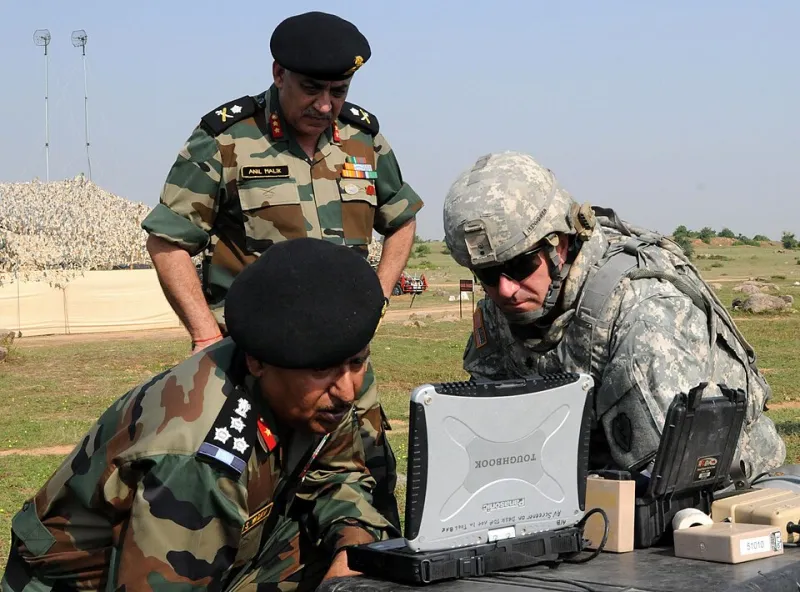
Photo: U.S. Department of Defense Current Photos, Public domain, via Wikimedia Commons
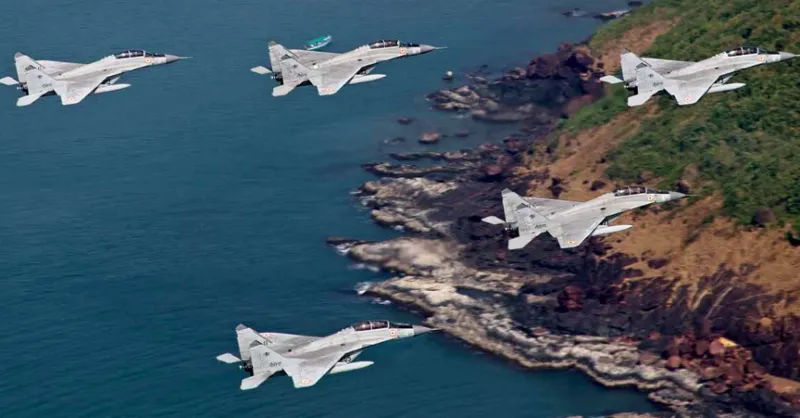
For decades, India's military modernization story was told through the lens of foreign procurement — Russian MiGs, French submarines, American transport aircraft. Today, a fundamentally different narrative is taking shape, one written not in diplomatic cables but in lines of code, drone schematics, and cybersecurity frameworks emerging from the country's own technology corridors.
India is quietly engineering a defense-industrial transformation that deserves far closer attention from policymakers in Washington than it has thus far received.
The Government Mandate That Changed Everything
The pivot began in earnest with New Delhi's 'Aatmanirbhar Bharat' — or 'Self-Reliant India' — initiative, launched in 2020. What initially appeared to be a broad economic slogan has since crystallized into a structured defense procurement revolution. The Ministry of Defence has published successive positive indigenization lists, effectively banning the import of hundreds of weapons systems and components that India now mandates must be produced domestically.
The Defense Research and Development Organisation (DRDO), long criticized for sluggish timelines and cost overruns, has been supplemented — and in some domains effectively challenged — by a new generation of private-sector players. The iDEX framework, the Innovations for Defence Excellence program, has channeled government seed funding toward startups operating in domains ranging from swarm drone technology to quantum communication encryption.
The results are beginning to materialize in tangible form. Companies such as ideaForge Technology, now publicly listed on Indian stock exchanges, have supplied fixed-wing and rotary unmanned aerial vehicles to the Indian Army for high-altitude surveillance operations along the Line of Actual Control with China. Sagar Defence Engineering has demonstrated underwater drone prototypes capable of mine-laying and intelligence-gathering missions in littoral environments. These are not proof-of-concept exercises — they represent fielded or near-fielded capabilities.
Artificial Intelligence Enters the Operations Room
Perhaps the most consequential dimension of this transformation involves artificial intelligence. India's armed forces have begun integrating AI-driven decision-support systems into logistics, intelligence analysis, and target acquisition workflows. The Centre for Artificial Intelligence and Robotics, a DRDO laboratory based in Bengaluru, has been at the forefront of developing machine-learning algorithms designed to process satellite imagery and flag anomalous activity along sensitive border regions.
Private firms are also contributing meaningfully. Bengaluru-based Tonbo Imaging has developed AI-enhanced electro-optical and infrared sensor suites that improve target identification in low-visibility conditions — technology with direct battlefield applicability. Meanwhile, companies operating within the National Defence Industrial Corridor in Uttar Pradesh are developing autonomous ground vehicles intended to reduce soldier exposure in mine-prone terrain.
For American defense analysts, these developments carry a dual significance. On one hand, they signal that India is becoming a more capable and self-sufficient military partner — one less dependent on foreign suppliers and therefore more strategically autonomous. On the other hand, they also suggest a growing pool of interoperable technology that could underpin deeper joint operational frameworks between US and Indian forces.
Cyber Warfare: The Invisible Frontier
Less visible but equally consequential is India's accelerating investment in cyber warfare capabilities. The Defence Cyber Agency, established in 2019 under the integrated defense framework, has been steadily expanding its offensive and defensive mandate. Simultaneously, India's broader cybersecurity ecosystem — anchored by institutions such as the Indian Computer Emergency Response Team and a constellation of private-sector firms — is feeding talent and tooling into military applications.
India's experience with state-sponsored cyber intrusions, particularly from Chinese actors who targeted power grid infrastructure and financial systems during periods of heightened border tension in 2020 and 2021, has accelerated the urgency of this build-up. The attacks served as a galvanizing event, prompting both increased defensive investment and a more explicit acknowledgment within Indian strategic circles that cyberspace constitutes a legitimate and active theater of conflict.
US Cyber Command has taken notice. Joint exercises and intelligence-sharing arrangements between American and Indian cyber defense entities have quietly expanded, though the full contours of this cooperation remain classified. What is publicly known suggests a relationship of growing operational depth.
What This Means for US-India Defense Cooperation
The implications for the bilateral defense relationship are substantial. The United States and India have progressively deepened their defense ties over the past two decades, culminating in India's designation as a Major Defense Partner — a status that facilitates technology transfer arrangements otherwise reserved for formal treaty allies.
The growth of India's indigenous defense-tech sector both complicates and enriches this relationship. It complicates it because a more self-reliant India may prove a less predictable procurement partner for American defense contractors who have grown accustomed to significant market access. It enriches it because India's homegrown capabilities in domains such as AI-enabled ISR (Intelligence, Surveillance, and Reconnaissance) and cyber tools create opportunities for genuine co-development rather than simple buyer-seller relationships.
The iCET framework — the Initiative on Critical and Emerging Technology — launched jointly by President Biden and Prime Minister Modi in 2023, represents perhaps the most ambitious attempt to institutionalize this co-development potential. Under its umbrella, American and Indian firms are exploring joint ventures in semiconductor manufacturing, advanced propulsion, and AI-enabled defense systems. Early progress has been measured, but the structural foundation is in place.
A Regional Balance in Flux
Beyond the bilateral dimension, India's defense-tech surge carries implications for the broader regional military balance. Pakistan's defense establishment is monitoring developments with evident concern, while China's military planners must reckon with an adversary that is no longer simply purchasing capability off foreign shelves but actively generating it domestically.
The speed of India's transformation should not be overstated — significant challenges remain, including supply chain vulnerabilities, quality control inconsistencies in some domestic production programs, and the perennial difficulty of scaling promising prototypes into mass-produced fielded systems. These are genuine constraints that temper optimism.
Nevertheless, the trajectory is unmistakable. India's defense-industrial ecosystem, once characterized by bureaucratic inertia and import dependence, is undergoing a structural shift that will shape the country's military posture for decades to come. For Washington, understanding and engaging with that shift is not merely an option — it is a strategic imperative.