The Instructors Abroad: India's Low-Profile Training Diplomacy and the Contest for the Global South
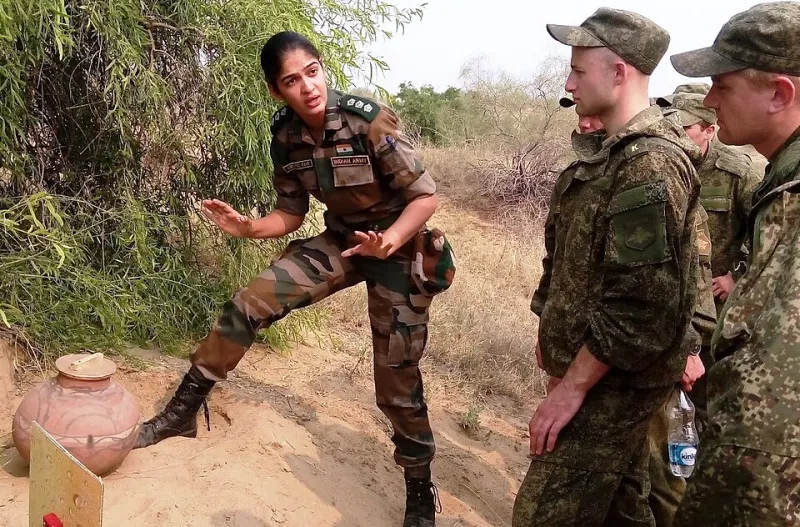
Photo: Indian Army, GODL-India, via Wikimedia Commons
Military influence is usually measured in bases, warships, and arms sales. India's approach in the Global South often looks different. It arrives through training teams, officer scholarships, staff college placements, and quiet partnerships with foreign militaries. The footprint is small. The timeline is long. The political signal is subtle. Yet by 2026, that low-profile training diplomacy has become one of India's most consequential instruments of influence, and it deserves more attention from Washington than it has received.
Influence Without Bases
India does not operate a network of overseas bases comparable to those of the United States. It does not sell weapons with the same aggressive financing terms that China has used to expand its reach. What India does offer is training. Indian academies host officers from Africa, Southeast Asia, the Middle East, and the Indian Ocean rim. Indian training teams deploy abroad to instruct in counterinsurgency, peacekeeping, maritime law enforcement, and staff planning. The scale is not always visible in headlines, but the effects accumulate.
Training is a patient form of influence. It creates personal networks, familiarizes partner officers with Indian doctrine, and builds habits of consultation. It also signals reliability. A partner force that trains with India year after year develops a relationship that is difficult to displace with a one-off arms package. In countries where institutions are weak and coups are a recurring risk, that kind of sustained professional contact can matter as much as hardware.
The African Footprint
Africa is a particularly important arena. Indian officers have served in peacekeeping missions across the continent, and India's defense academies have trained generations of African officers. The curriculum is often practical: junior leadership, logistics, civil-military relations, and peace support operations. These are not prestige programs designed to sell fighter jets. They are working-level courses that shape how partner militaries function.
China's model in Africa has emphasized arms sales, infrastructure, and access. That model has produced results, but it has also generated concerns about debt, dependency, and governance. India's model is thinner but often more trusted. It does not demand exclusive alignment. It does not usually come with a basing agreement. For African governments seeking diversification, that is part of the appeal.
Southeast Asia and the Indian Ocean Rim
In Southeast Asia, India's training diplomacy focuses on counterinsurgency, maritime domain awareness, and humanitarian assistance and disaster relief. These are areas where Indian experience is relevant and where partner forces face real operational demands. India's own military has deep experience in counterinsurgency and in complex disaster response. Sharing that experience is a form of soft power that does not require a large footprint.
Along the Indian Ocean rim, training often intersects with coast guard cooperation. Small states need help with maritime surveillance, fisheries protection, and search and rescue. India can provide courses, advisors, and equipment. The result is a web of relationships that stretches from the Maldives to Mauritius and beyond. These relationships are not alliances, but they are assets.
Why Washington Should Pay Attention
The United States has its own training programs, including International Military Education and Training and a range of regional exercises. Those programs are valuable, but they are often constrained by budget cycles, congressional conditions, and bureaucratic friction. India's model is smaller, but it can be more flexible and more locally attuned. That does not mean Washington should outsource its relationships to New Delhi. It means the two countries should look for complementarities.
There is room for joint training of third-country officers, particularly in peacekeeping, maritime security, and disaster response. There is room for shared curricula and exchanged instructors. There is also room for coordinated messaging about professional military education. If the United States and India can present a common vision of officer development, they can offer partner forces an alternative to Chinese training models that emphasize political loyalty over professional competence.
Limits of the Quiet Approach
Training diplomacy has limits. It is slow. It does not deter aggression. It can be undercut by budget cuts, language barriers, and institutional resistance. India's own military training establishments are stretched, and expansion requires investment. There is also a risk of overstating India's reach. A few training teams do not constitute a regional order. They are one instrument among many.
India's strategic autonomy also imposes constraints. New Delhi will not want its training programs to be seen as a vehicle for American strategy. That is why any U.S.-India cooperation in this space must be framed carefully. The goal should be to strengthen partner capacity, not to conscript India into a bloc.
A Practical Agenda
The most useful steps are modest. Washington can expand funding for joint training with Indian institutions. It can encourage exchanges between American and Indian professional military education schools. It can support Indian-led courses for partner forces in areas where India has comparative advantage, such as peacekeeping and maritime law enforcement. It can also improve data sharing on training outcomes, so that both countries know what works.
None of this will produce dramatic headlines. That is the point. India's training diplomacy is a long game, played through relationships rather than deployments. For a United States looking for durable influence in the Global South, it is a game worth understanding.