Sovereign Skies: How India's Layered Air Defense Architecture Is Redrawing the Strategic Map Across the Indo-Pacific

Photo by Photo by Jarnail Singh on Unsplash on Unsplash
A New Ceiling Over the Subcontinent
For decades, the conventional wisdom among Western defense planners held that India's air defense posture was adequate for deterrence but insufficient for sustained, high-intensity aerial conflict against peer adversaries. That assessment is rapidly becoming obsolete. Over the past several years, India has undertaken one of the most ambitious overhauls of its air defense capabilities in its post-independence history—one that is drawing serious attention from strategic communities in Washington, Beijing, and beyond.
The transformation is not merely about acquiring new hardware. It represents a fundamental architectural shift: from a patchwork of imported systems with limited interoperability to a layered, domestically integrated framework capable of engaging threats across multiple altitudes, ranges, and threat profiles simultaneously. For a nation that shares contested borders with two nuclear-armed adversaries, this evolution is not academic. It is existential.
Layers Upon Layers: The Architecture of Denial
India's emerging air defense structure operates across what military planners describe as a multi-tiered envelope. At the outermost layer, long-range surface-to-air missile systems provide engagement capability against high-altitude threats, including ballistic missiles and advanced strike aircraft operating at extended standoff distances. The S-400 Triumf systems, acquired from Russia despite significant diplomatic friction with Washington, form the backbone of this long-range tier—providing coverage that extends well beyond India's immediate borders and into airspace that adversaries would need to transit during any serious aerial campaign.
Below that envelope, India has invested heavily in medium-range platforms. The domestically developed Akash missile system, produced under the Defence Research and Development Organisation, has matured considerably from its early iterations. The Akash-NG variant now offers enhanced maneuverability and resistance to electronic countermeasures, representing a meaningful leap in indigenous capability. Crucially, the Akash program demonstrates that India is not merely assembling imported components but developing genuine engineering depth in air defense—a distinction that carries strategic weight.
At shorter ranges, a combination of legacy systems and newer point-defense platforms fills the terminal layer, designed to intercept cruise missiles, precision-guided munitions, and unmanned aerial vehicles that might penetrate the outer tiers. This final layer has taken on renewed urgency as the proliferation of low-cost drones and loitering munitions has complicated air defense planning for militaries worldwide.
The Radar Revolution Beneath the Headlines
Perhaps the least-discussed but most consequential element of India's air defense modernization is the expansion of its indigenous radar network. Advanced surveillance and tracking radars—including the domestically produced Arudhra and LRDE-developed systems—are being deployed across the country's northern and western frontiers, creating overlapping coverage zones that significantly reduce the blind spots that adversaries might otherwise exploit.
This radar infrastructure serves a dual purpose. Operationally, it feeds targeting data into India's integrated air command and control system, enabling faster engagement timelines and more efficient allocation of interceptor resources. Strategically, it signals to potential adversaries that the airspace over and around India is no longer a permissive environment. Penetrating it carries escalating costs that must be factored into any offensive planning calculus.
For American defense analysts, the expansion of India's sensor architecture carries a particular significance. A nation with robust, sovereign radar coverage is a nation that can contribute meaningfully to regional situational awareness without depending entirely on US satellite constellations or intelligence-sharing arrangements. That independence, paradoxically, makes India a more reliable partner—one whose capabilities do not evaporate when diplomatic conditions shift.
The China Variable
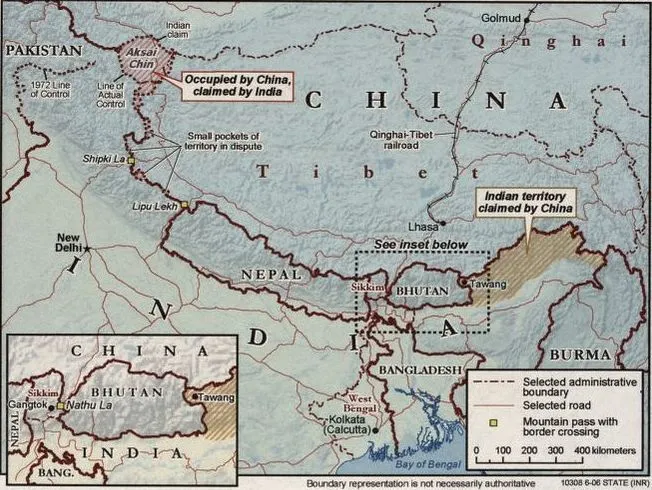
No serious analysis of India's air defense investments can ignore the primary driver behind them: the sustained and accelerating buildup of Chinese air power along the Line of Actual Control and across the broader Indo-Pacific theater. China's People's Liberation Army Air Force has invested heavily in fifth-generation fighter platforms, advanced cruise missiles, and hypersonic weapons that are specifically designed to challenge and overwhelm legacy air defense architectures.
India's response has been calibrated but determined. The layered approach to air defense is explicitly designed to impose costs on any Chinese aerial campaign targeting Indian territory or military infrastructure. By denying the PLA Air Force the luxury of uncontested airspace over northern India, New Delhi is effectively raising the threshold for Chinese military adventurism—a strategic contribution that benefits not only India but every nation with an interest in regional stability.
Washington should note that this deterrent effect does not require formal alliance structures to function. India's air defense capabilities generate strategic friction for Beijing regardless of whether New Delhi and Washington are operating under a mutual defense treaty. The shield, in other words, casts a wider shadow than its builders alone.
Atma Nirbhar and the Limits of Dependence
India's air defense modernization is unfolding within the broader context of the Atma Nirbhar Bharat—or self-reliant India—initiative, which has set ambitious targets for domestic defense production across all domains. The implications for air defense are significant. A nation that manufactures its own radar systems, its own interceptor missiles, and its own command-and-control software is a nation that cannot be coerced through export controls or technology-transfer restrictions.
This matters enormously to US strategists who have grown accustomed to leveraging technological dependence as a tool of alliance management. India is deliberately reducing its exposure to that leverage—not out of hostility to Washington, but out of a clear-eyed recognition that genuine strategic autonomy requires indigenous capability. The Akash program, the development of the QRSAM quick-reaction surface-to-air missile, and ongoing work on hypersonic interceptors all reflect this philosophy.
For American defense industry partners, this trajectory presents both a challenge and an opportunity. The window for deep technology collaboration with India remains open, but it will not remain open indefinitely as Indian capabilities mature. Those who engage now, on terms that respect Indian sovereignty and transfer genuine expertise rather than finished products, will find a more durable partnership than those who attempt to maintain the traditional supplier-client dynamic.
What Washington Must Understand
The temptation in Washington is to view India's air defense buildup primarily through the lens of what it contributes to US strategic objectives in the Indo-Pacific. That framing, while understandable, misses the more fundamental point. India is not building this architecture for American benefit. It is building it because the security environment on its borders demands it.
The fact that a more capable Indian air defense posture also constrains Chinese options, complicates Pakistani planning, and contributes to regional stability is a convergence of interests—not a dependency relationship. American policy that proceeds from an accurate understanding of this distinction will be far more effective than policy that assumes Indian capabilities can be directed or withheld based on diplomatic conditions.
India's sovereign skies are becoming one of the most consequential strategic facts in Asia. The nations that recognize this early will be better positioned to navigate the Indo-Pacific's evolving security architecture than those still operating on outdated assumptions about New Delhi's role and reach.