Caught Between Two Fires: How India's Dual-Border Threat Is Rewriting the Risk Calculus for US Strategic Planners
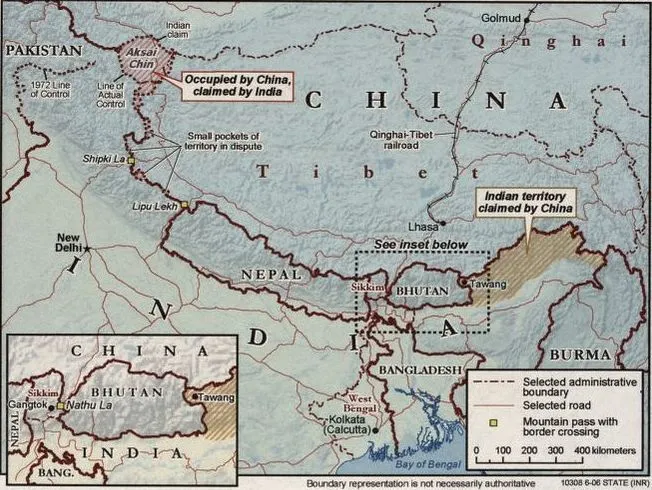
Photo: United States. Central Intelligence Agency., Public domain, via Wikimedia Commons
In the war-gaming scenarios that periodically circulate through American defense think tanks, one contingency has begun attracting increasing analytical attention: the possibility that India could find itself managing active military pressure on two geographically distinct and strategically demanding fronts simultaneously. The implications of such a scenario extend far beyond South Asia. They reach directly into the calculations that underpin America's entire Indo-Pacific strategy.
To understand why, it is necessary to examine both threats on their own terms before considering what their convergence would mean.
The Northern Frontier: China's Deliberate Pressure Campaign
The 2020 Galwan Valley clash was a watershed moment, not because it fundamentally altered the military balance along the Line of Actual Control, but because it shattered a decade of carefully maintained diplomatic ambiguity. Beijing's decision to contest territory in eastern Ladakh through incremental incursion and infrastructure development confirmed what Indian strategists had long suspected: China views the Himalayan frontier as a tool of strategic pressure, to be activated or eased according to broader geopolitical objectives.
Since Galwan, India has responded with a sustained and costly militarization of its northern border. New forward airbases, hardened infrastructure, advanced air defense deployments, and the repositioning of mountain strike corps formations have all been accelerated. The Indian Army has stationed additional troops in forward areas on a semi-permanent basis—a significant departure from pre-2020 posture.
This forward deployment posture consumes resources. It ties down elite formations, demands sustained logistical investment, and places continuous pressure on the Indian Air Force's operational tempo. The Chinese People's Liberation Army, operating from the strategic depth of the Tibetan plateau with mature rail and road infrastructure, faces no comparable constraint on its side of the LAC.
The Western Front: Pakistan's Persistent Calculus
If China represents a structural, long-term challenge to India's northern security, Pakistan represents a more volatile and operationally immediate one. The two countries have fought four wars and endured countless lower-intensity confrontations. Islamabad's doctrine of strategic ambiguity—maintaining a nuclear deterrent while tolerating or sponsoring sub-conventional pressure against India—has created a security environment in which escalation can be triggered by events neither government fully controls.
The 2019 Balakot airstrikes and the subsequent aerial engagement demonstrated that the threshold for Indian conventional military action against Pakistan has lowered. It also demonstrated that Pakistan's response options, constrained by its own nuclear signaling requirements, are neither predictable nor negligible. Any future crisis along the Line of Control carries with it the inherent risk of rapid escalation into a domain—nuclear brinkmanship—that no external power, including the United States, has reliable tools to manage.
For Washington, this is the most uncomfortable variable in the South Asian equation. American influence over Pakistani military decision-making, once substantial during the Cold War and the post-9/11 period, has eroded significantly. Islamabad's deepening strategic alignment with Beijing—formalized through the China-Pakistan Economic Corridor and reinforced through arms transfers and diplomatic solidarity—means that in any future India-Pakistan crisis, China would not be a neutral party.
The Convergence Problem
Here lies the crux of Washington's strategic anxiety. Beijing and Islamabad share a formal all-weather partnership that is increasingly operationalized rather than merely rhetorical. The possibility that China could choose to intensify pressure along the LAC precisely at a moment when India is managing a crisis with Pakistan—or vice versa—is not a fringe scenario. It is a contingency that Indian military planners treat as a foundational planning assumption and one that American strategists are only beginning to take seriously.
A two-front crisis of meaningful intensity would not merely strain India's military capacity. It would force New Delhi to make triage decisions about resource allocation that could reduce its availability as a partner in broader Indo-Pacific contingencies. The Indian Navy, which American planners increasingly view as a critical counterweight to Chinese maritime expansion in the Indian Ocean Region, would face competing demands for assets if the Army and Air Force were simultaneously committed to two land frontiers.
The strategic window that India's naval presence opens for American power projection in the Indian Ocean—covering sea lanes through which a significant portion of global energy trade flows—could narrow considerably under such circumstances.
Opportunities Within the Constraint
It would be a mistake to view this dilemma purely through the lens of vulnerability. India's two-front exposure has accelerated precisely the kind of defense modernization and indigenous capability development that makes it a more capable long-term partner for the United States. The urgency of the China threat in particular has driven procurement decisions—advanced air defense systems, long-range precision strike assets, undersea warfare capabilities—that enhance India's overall military profile.
Moreover, India's experience managing complex, multi-domain security challenges along contested borders provides operational expertise and institutional knowledge that no amount of peacetime training can replicate. The Indian Army's high-altitude warfare doctrine, developed through decades of deployment in some of the world's most demanding terrain, is a form of strategic capital that American planners are increasingly interested in accessing through joint exercises and doctrinal exchange.
The Coordination Imperative
What the two-front dilemma ultimately demands from Washington is not sympathy but structural adaptation. American strategic planning for the Indo-Pacific must account for the realistic possibility that India's military availability will be constrained by its own security requirements at precisely the moments when American planners might most want it engaged.
This means investing more deeply in the resilience of the bilateral relationship—building communication channels, pre-positioning frameworks, and crisis consultation mechanisms that function under pressure rather than only in stable conditions. It means resisting the temptation to treat India as a deployable asset in American strategic architecture, and instead engaging it as a sovereign power with its own threat hierarchy.
India's two-front dilemma is not Washington's problem to solve. But it is very much Washington's problem to understand.