Unmanned and Unstoppable: How India's Indigenous Drone Program Is Giving Washington a Strategic Edge Over Beijing
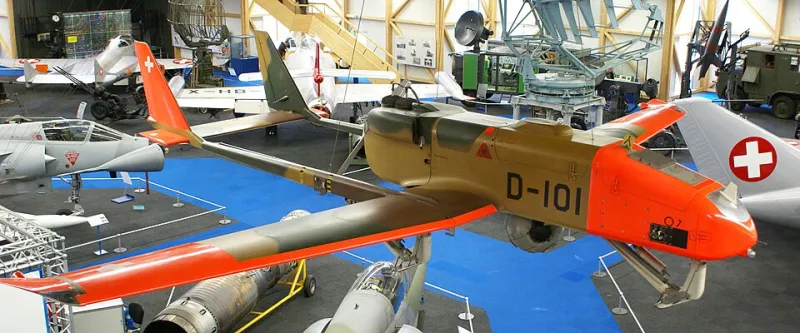
Photo: Sandstein, Public domain, via Wikimedia Commons
For years, the global conversation about unmanned aerial systems has been dominated by two names: the United States and China. Beijing, in particular, has leveraged its state-directed industrial apparatus to flood international markets with affordable, capable drones—from the CH-4 and Wing Loong series to the smaller commercial platforms that have quietly found their way into conflict zones from the Middle East to sub-Saharan Africa. Washington has watched this proliferation with mounting unease. What has received far less attention, however, is the quiet but accelerating rise of a third player whose drone ambitions carry enormous strategic implications: India.
New Delhi's push to develop an indigenous unmanned systems capability is no longer a future aspiration. It is a present-tense reality, and one that defense planners in Washington would be wise to study closely.
Building from the Ground Up: India's Unmanned Systems Portfolio
The cornerstone of India's military drone program is the Rustom series, developed by the Defence Research and Development Organisation (DRDO). The Rustom-II, also known as TAPAS-BH-201, is a medium-altitude, long-endurance (MALE) platform designed for intelligence, surveillance, and reconnaissance (ISR) missions. With an operational ceiling exceeding 28,000 feet and an endurance of roughly 24 hours, it is broadly comparable in mission profile to the American MQ-9 Reaper's predecessor generation—a significant achievement for a program developed almost entirely within India's domestic defense-industrial base.
But the more consequential platform may be the Ghatak, India's stealth unmanned combat aerial vehicle (UCAV). Still in development, the Ghatak is designed for strike missions and is intended to operate in contested airspace where manned aircraft would face unacceptable risk. Its flying-wing configuration—eerily reminiscent of the US Air Force's own X-47B demonstrator—signals that Indian engineers are not simply iterating on legacy designs. They are building toward a next-generation capability.
Beyond these headline programs, India's drone ecosystem extends into loitering munitions, swarm drone research, and maritime surveillance UAVs developed for the Indian Navy. The Aeronautical Development Establishment (ADE) and a growing constellation of private-sector firms, energized by the government's 'Atmanirbhar Bharat' (self-reliant India) initiative, are collectively producing a defense-industrial base that is far more diverse and resilient than it was even five years ago.
Why This Matters to Washington
The United States faces a structural problem in the drone competition with China. American export control regimes—particularly the Missile Technology Control Regime (MTCR) and International Traffic in Arms Regulations (ITAR)—constrain Washington's ability to freely share its most advanced unmanned systems with partners. China faces no such restrictions on its own exports, giving Beijing a commercial and diplomatic advantage in arming third parties.
India, by contrast, is a democracy with an increasingly aligned set of strategic interests, a signatory to foundational defense agreements with the US including LEMOA, COMCASA, and BECA, and a country that has explicitly positioned itself as a competitor to China's regional influence. An Indian drone industry that reaches maturity does not merely add one more capable military to the US-aligned coalition in the Indo-Pacific—it creates an alternative supply chain, an alternative design philosophy, and an alternative set of partnerships that Beijing cannot easily replicate or subvert.
The 2023 decision by the Indian government to purchase MQ-9B SkyGuardian drones from General Atomics—a deal valued at approximately $3.5 billion—was significant not just for the capabilities it delivers to the Indian armed forces, but for the signal it sent about interoperability. Indian and American unmanned systems are increasingly being designed to operate within shared data architectures and communication protocols. That is the foundation of genuine joint operational capability.
The Asymmetric Calculus
China's People's Liberation Army has invested heavily in drone warfare, not merely as a supplement to conventional forces but as a central pillar of its anti-access/area-denial (A2/AD) strategy. PLA doctrine envisions swarms of autonomous and semi-autonomous platforms overwhelming an adversary's air defenses, disrupting command-and-control networks, and enabling precision strikes deep behind enemy lines—all while keeping Chinese pilots out of harm's way.
India's drone program, viewed through this lens, is not simply a modernization effort. It is a direct counter to a specific threat calculus. India shares a 3,488-kilometer disputed border with China, and the 2020 Galwan Valley clash demonstrated in blood that this frontier is not a relic of Cold War-era geopolitics. It is an active, contested space where unmanned systems—for surveillance, logistics, and strike—have immediate and urgent utility.
For the US, India's ability to independently contest Chinese unmanned capabilities along the Himalayan frontier, in the Indian Ocean, and in the broader Indo-Pacific littoral reduces the burden on American forces and complicates Beijing's strategic planning in ways that no other partner nation currently can.
The Road Ahead: Co-development and Co-production
Perhaps the most consequential near-term development is the growing momentum behind US-India defense co-production. The iCET (Initiative on Critical and Emerging Technology) framework, launched in 2023, explicitly identifies unmanned systems as a priority domain for bilateral cooperation. American defense firms including General Atomics, Shield AI, and others are actively exploring joint ventures with Indian counterparts under the government's revised foreign direct investment rules for defense.
This is not charity. American defense firms benefit from India's relatively lower manufacturing costs, its deep engineering talent pool, and access to a domestic market that the Indian government is explicitly redirecting away from Russian and European suppliers. For Washington's strategic planners, the arithmetic is straightforward: a stronger Indian drone industry is a weaker Chinese monopoly on the global unmanned systems market.
India's drone revolution is still a work in progress. Delays have plagued the Rustom program, and the Ghatak remains years from operational deployment. But the trajectory is unmistakable, and the strategic logic is compelling. In the contest for dominance over unmanned warfare—a contest that will define the character of 21st-century conflict—India is emerging as an asset that Washington can neither afford to overlook nor take for granted.