Ports, Runways, and Resolve: How India's Military Logistics Network Is Quietly Anchoring American Power in the Indo-Pacific
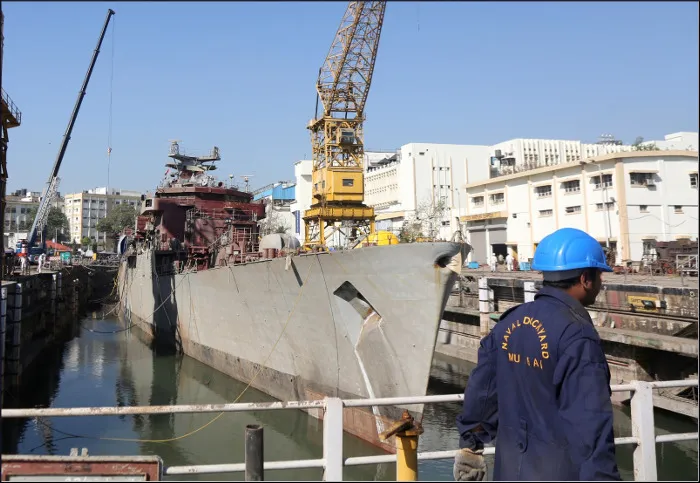
Photo: Indian Navy, GODL-India, via Wikimedia Commons
In the calculus of great-power competition, geography remains stubbornly decisive. Aircraft carriers and fifth-generation fighters are formidable instruments of power—but only when they can be fueled, armed, and sustained far from home. It is here, in the unglamorous but indispensable domain of military logistics, that India has quietly assembled one of the most strategically significant infrastructures in the Indo-Pacific. And it is here that Washington is increasingly paying attention.
The conversation about India's role in American strategic planning has long centered on diplomatic alignment, shared democratic values, and the symbolism of joint declarations. Those elements matter. But beneath the summit communiqués lies a more concrete and operationally meaningful reality: India is becoming a logistics empire, and its ports, airfields, and supply networks are emerging as a genuine lifeline for U.S. and allied forces operating across a vast and contested maritime theater.
The Geographic Dividend
India's strategic value begins with a fact no amount of diplomacy can manufacture: location. The Indian subcontinent juts southward into the Indian Ocean like a natural aircraft carrier, flanked on the west by the Arabian Sea and on the east by the Bay of Bengal. The Andaman and Nicobar Islands extend India's reach further still, sitting astride the Malacca Strait—the chokepoint through which roughly 80 percent of China's oil imports must pass.
This geography grants India an extraordinary capacity to monitor, interdict, or support operations across the critical sea lanes connecting the Persian Gulf to the South China Sea. For American military planners, who must consider the vast distances involved in any sustained Indo-Pacific contingency, India's position is not merely convenient—it is potentially irreplaceable.
The Pentagon has recognized this for years, but the institutional frameworks to exploit it have only recently matured. The 2016 Logistics Exchange Memorandum of Agreement (LEMOA), followed by the Communications Compatibility and Security Agreement (COMCASA) in 2018 and the Basic Exchange and Cooperation Agreement (BECA) in 2020, collectively constitute the foundational architecture through which American and Indian forces can now share bases, exchange logistical support, and operate with a degree of interoperability that would have been unthinkable a decade ago.
Infrastructure on the Ground
Beyond agreements, India has invested heavily in the physical infrastructure that gives those agreements operational meaning. The Indian Navy's expansion of facilities at INS Kadamba in Karwar—sometimes described as India's largest naval base—reflects an ambition to project power well into the western Indian Ocean. Simultaneously, the development of Port Blair in the Andaman and Nicobar Islands has transformed what was once a modest outpost into a strategically relevant forward operating hub.
On the eastern seaboard, the port at Vishakhapatnam serves as the headquarters of India's Eastern Naval Command and has seen consistent infrastructure upgrades. Along India's western coast, the naval station at Kochi and the joint logistics node at Mumbai provide additional nodes in a network that spans thousands of miles of coastline.
Air bases tell a similar story. Facilities at Car Nicobar, within the Andaman chain, provide India—and by extension its partners—with a forward air presence that overlooks the Malacca Strait directly. The significance of this cannot be overstated in any scenario involving Chinese naval movements through Southeast Asian waters.
For the United States, access to these facilities under LEMOA means that American naval vessels and aircraft can now replenish, refuel, and rearm at Indian installations on a reciprocal basis. In a prolonged contingency, the ability to avoid the 7,000-mile journey back to Diego Garcia or Guam for routine sustainment could prove operationally decisive.
The Supply Chain Dimension
Logistics is not only about fixed infrastructure. It is also about the depth and reliability of supply chains. India's growing defense manufacturing sector—anchored by public-sector enterprises and an increasingly capable private industry—means that the country is developing the capacity to produce and supply critical military materiel at scale.
From ammunition and spare parts to fuel and rations, a well-stocked Indian logistics ecosystem reduces the vulnerability of any allied force operating in the region to supply chain disruption. China has invested considerable resources in developing anti-access and area-denial capabilities specifically designed to sever American supply lines in a conflict scenario. An Indian logistics backbone, spread across a vast subcontinent and defended by India's own formidable military, presents a far more resilient alternative to forward-deployed American supply nodes that might be vulnerable to Chinese ballistic missile strikes.
This is not lost on American defense officials. The 2022 U.S. National Defense Strategy explicitly identifies integrated deterrence—the idea that American military power must be woven together with the capabilities of allies and partners—as the organizing principle of U.S. defense planning. India's logistics infrastructure is, in this framework, not a peripheral benefit but a core component of the strategy.
What India Expects in Return
New Delhi's willingness to develop this logistics partnership is not unconditional, and American policymakers would be mistaken to treat it as such. India's strategic culture prizes autonomy above almost all other foreign policy values. The country's leadership has been consistent and clear: India will not serve as a base for American offensive operations, nor will it subordinate its own strategic interests to Washington's preferences.
What India is willing to offer is access, interoperability, and a shared commitment to a rules-based order in the Indo-Pacific. The distinction matters enormously. A logistics partner that operates on its own terms is a different proposition from an ally bound by treaty obligations. American planners must design their regional strategy around what India will actually provide, not what they might wish it would.
This requires a degree of strategic maturity in Washington that has not always been forthcoming. The temptation to treat India as a junior partner—to be managed rather than consulted—has historically strained the relationship. As India's logistical value grows, so too does its leverage, and with it, the necessity of treating New Delhi as an equal stakeholder in regional security architecture.
The Longer View
The construction of a durable logistics partnership between India and the United States is a generational project, not a transactional arrangement. It requires sustained investment in interoperability, mutual trust built through consistent engagement, and a shared understanding of the threat environment that goes beyond periodic crisis management.
China's military planners are watching this development closely. The prospect of an Indian logistics network supporting American and allied operations across the Indo-Pacific significantly complicates Beijing's strategic calculus. It means that any Chinese attempt to dominate the region's sea lanes must contend not only with American carrier groups but with a vast, resilient, and geographically distributed support architecture rooted in the world's most populous democracy.
India's ports and runways are, in this sense, more than infrastructure. They are a statement of strategic intent—and an increasingly indispensable foundation for the kind of sustained American presence that the Indo-Pacific's security demands.