India's Defense Industrial Awakening: The Quad's Quiet Cornerstone That Washington Cannot Afford to Ignore

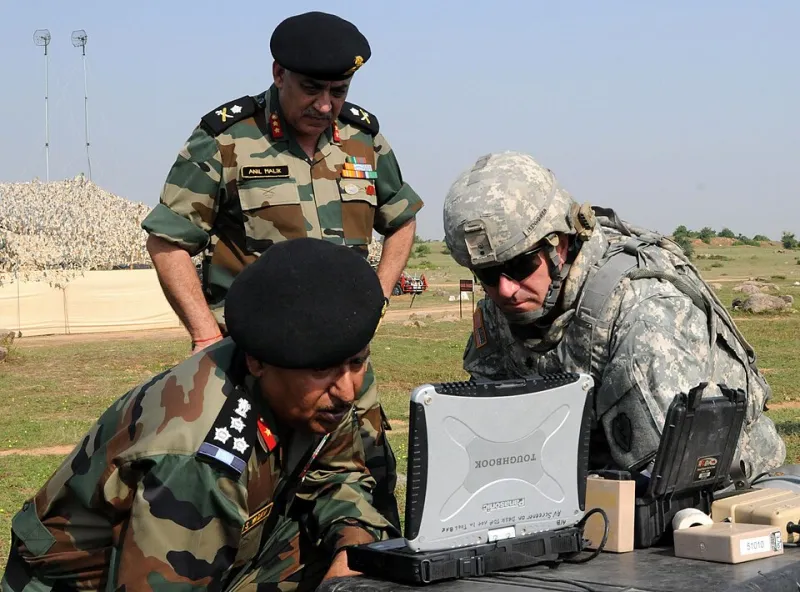
Photo: Ash Carter, CC BY 2.0, via Wikimedia Commons
For much of the past decade, discussions about the Quadrilateral Security Dialogue—the strategic grouping of the United States, India, Japan, and Australia—have centered on naval exercises, diplomatic communiqués, and high-level summits. What has received comparatively less attention in Washington policy circles is a more fundamental question: who will actually build, sustain, and supply the hardware that gives the Quad its teeth? Increasingly, the answer points to India.
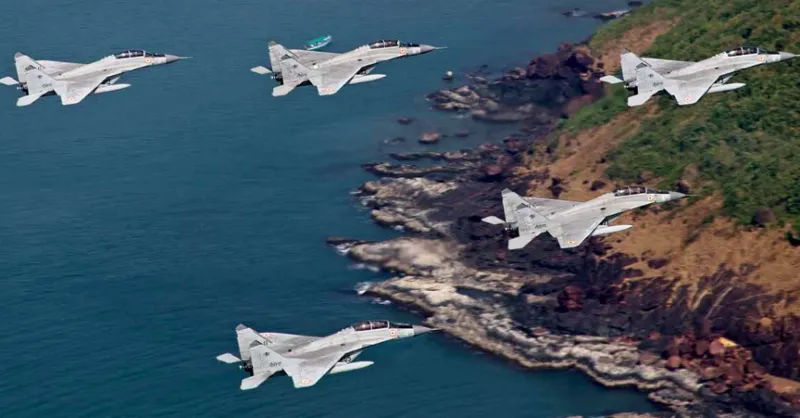
New Delhi's defense industrial complex, once dismissed as a cautionary tale of bureaucratic inertia and import dependency, has undergone a structural transformation in recent years. The consequences of that transformation extend well beyond South Asia, touching the core of American strategic planning in the Indo-Pacific.
From Import Dependency to Indigenous Capability
India's journey toward defense self-reliance did not happen overnight. For decades, the country ranked among the world's largest arms importers, relying heavily on Russian platforms, American equipment, and European systems to fill critical capability gaps. That dependency carried both financial costs and strategic vulnerabilities—a reality that successive Indian administrations acknowledged but struggled to address.
The shift began in earnest following the announcement of the 'Atmanirbhar Bharat' (Self-Reliant India) initiative, which placed defense manufacturing at the center of a broader industrial policy overhaul. Positive indigenization lists—essentially bans on the import of specified defense items—forced the Indian armed forces to source increasingly sophisticated equipment from domestic producers. The results have been notable. India's domestic defense production has climbed substantially, with output from public sector undertakings and private manufacturers reaching record levels. Exports, once negligible, have grown to encompass dozens of partner nations.
For the Quad, this matters enormously. An alliance architecture that depends on a single dominant supplier—or on supply chains vulnerable to disruption—is structurally fragile. India's expanding production capacity introduces a second major manufacturing node into the partnership's logistics ecosystem, one that is geographically proximate to potential theaters of concern and increasingly capable of producing competitive systems.
The Technology-Sharing Dimension
Beyond raw manufacturing output, the technology-sharing agreements that New Delhi has concluded with Washington in recent years represent a qualitative leap in bilateral defense relations. The foundational agreements that govern defense cooperation—including the Communications Compatibility and Security Agreement and the Basic Exchange and Cooperation Agreement for Geo-spatial Cooperation—have unlocked data-sharing and interoperability arrangements that would have been unthinkable a generation ago.
More recently, the Initiative on Critical and Emerging Technology, known as iCET, has broadened the aperture further, encompassing artificial intelligence, advanced semiconductors, and space-based capabilities. For American defense planners, this creates a partner that is not merely a buyer of finished systems but a collaborator in the development of next-generation platforms.
The co-production of GE F414 jet engines for India's indigenous Tejas Mk2 fighter program is perhaps the most illustrative example. The agreement transfers significant manufacturing know-how to Indian industry while deepening the technological interdependence between the two countries. Crucially, it also creates industrial stakeholders on both sides of the Pacific with a vested interest in the partnership's continuity.
Strategic Geography and the Logistics Imperative
America's strategic challenge in the Indo-Pacific is, at its core, a logistics problem. Projecting and sustaining power across an ocean that spans more than 60 million square miles requires forward basing, pre-positioned supplies, and reliable partners capable of providing maintenance and replenishment support. India's geography—flanking the critical sea lanes of the Indian Ocean, commanding the approaches to the Persian Gulf, and sharing a contested land border with China—gives it a strategic position that no other Quad member can replicate.
India's expanding network of military logistics agreements, including the Logistics Exchange Memorandum of Agreement with the United States, enables American forces to access Indian facilities for refueling, resupply, and maintenance. Combined with India's own forward posture in the Andaman and Nicobar Islands—which sit astride the Malacca Strait—this creates a layered architecture of mutual support that significantly complicates adversarial planning.
The Contracts Beneath the Headlines
The commercial dimension of this relationship is often overlooked in geopolitical analysis, yet it carries substantial strategic weight. India has concluded major procurement agreements for American platforms including the MH-60R maritime helicopters, P-8I Poseidon maritime patrol aircraft, and C-17 Globemaster transport aircraft. These acquisitions do more than fill capability gaps—they embed American systems, maintenance protocols, and training pipelines into the Indian armed forces, creating durable links that outlast any individual administration in either capital.
Looking ahead, prospective deals involving armed unmanned aerial vehicles, additional fighter aircraft, and advanced artillery systems would deepen this integration further. Each contract represents not merely a commercial transaction but a strategic commitment with long-term implications for interoperability and alliance cohesion.
What Washington Must Recognize
American policymakers have sometimes approached India with a mixture of admiration and frustration—admiring its democratic credentials and strategic location while chafing at its historical reluctance to align formally with Western security structures. That frustration, while understandable, reflects a misreading of Indian strategic culture and ultimately serves no one's interests.
India is not, and will not become, a formal treaty ally in the mold of Japan or South Korea. Its tradition of strategic autonomy is deeply rooted and commands broad domestic political support. But formal alliance membership is not the relevant metric. What matters is whether India's capabilities, geography, and industrial base are oriented in ways that complement American strategic objectives in the Indo-Pacific. On that measure, the trajectory is unmistakably positive.
The Quad's long-term credibility as a security architecture depends not on the frequency of its summits but on the depth of the industrial, technological, and logistical sinews connecting its members. India is building those sinews with deliberate speed. Washington would do well to recognize that in the emerging competition for regional influence, New Delhi's factory floors may prove as consequential as its foreign policy pronouncements.