New Delhi's Quiet Reach: How India's Southeast Asian Intelligence Web Is Reshaping Washington's Strategic Vision
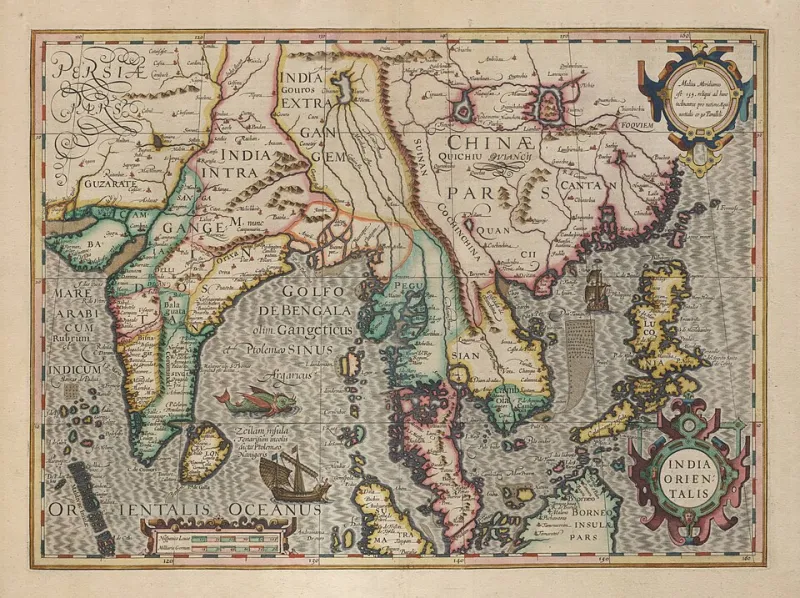
Photo: Jodocus Hondius I, Public domain, via Wikimedia Commons
For decades, Washington's intelligence posture in Southeast Asia was built on a familiar scaffold — bilateral agreements, Five Eyes adjacency, and a constellation of forward-deployed American assets. That architecture, however formidable in the Cold War context for which it was designed, carries a fundamental limitation in the current era: it is visibly American. In a region where governments balance sovereign pride against great-power pressure with extraordinary care, the United States' direct footprint can be as much a liability as an asset.
India has no such problem. And Washington, quietly but unmistakably, is beginning to understand what that means.
A Network Built on Trust, Not Treaties
India's intelligence relationships across Southeast Asia have been constructed through a combination of historical affinity, shared threat perception, and deliberate diplomatic investment over the better part of two decades. Unlike American partnerships, which are frequently formalized through legally binding frameworks that draw public scrutiny, India's arrangements tend to operate through less visible channels — defense attaché networks, joint training programs, maritime domain awareness agreements, and bilateral signals intelligence cooperation that rarely surfaces in official communiqués.
The results, according to analysts familiar with the region, are substantial. Vietnam, which maintains a posture of studied neutrality toward both Washington and Beijing, has deepened its defense intelligence exchanges with New Delhi considerably since the early 2010s. Hanoi's willingness to share maritime surveillance data from its South China Sea monitoring infrastructure — data that covers some of the most strategically critical waters on the planet — flows more readily through Indian channels than American ones. The political optics, for Hanoi, are simply more manageable.
Similar dynamics are at work in Indonesia, the Philippines, and to a lesser degree Myanmar, where India's historical relationships with military establishments predate the current era of great-power competition. New Delhi has invested systematically in these connections, offering training, equipment transfers, and interoperability frameworks that build trust at the institutional level rather than the governmental level alone.
The Five Eyes Gap and Why India Fills It
The Five Eyes alliance — comprising the United States, United Kingdom, Canada, Australia, and New Zealand — remains the most sophisticated multilateral intelligence-sharing arrangement in history. Its technical capabilities are unmatched. Its geographic blind spots, however, are real.
Southeast Asia sits in a complicated position relative to Five Eyes coverage. Australia provides meaningful regional presence, and American signals intelligence infrastructure in the Pacific is extensive. But the human intelligence dimension — the granular, relationship-dependent information that illuminates intentions rather than merely capabilities — has always been harder to generate from outside the region's cultural and political fabric.
India's network addresses precisely this gap. Indian intelligence services, particularly the Research and Analysis Wing, have cultivated sources and relationships across Southeast Asian capitals that reflect decades of investment in regional familiarity. New Delhi's diplomatic corps, its diaspora connections, and its historical role as a non-aligned power that never carried the ideological freight of Cold War American foreign policy all contribute to an access profile that Western agencies struggle to replicate.
For American strategic planners, the practical implication is significant. Intelligence passed through Indian channels carries a provenance and a texture that direct American collection in the region frequently cannot match. Washington is increasingly willing to structure its regional assessments around inputs that originate with New Delhi, even when those inputs cannot be independently verified through American sources.
Maritime Domain Awareness and the South China Sea Equation
Perhaps nowhere is India's intelligence value to Washington more concrete than in the maritime domain. The South China Sea remains the single most consequential arena of Sino-American strategic competition, and the ability to monitor Chinese naval movements, artificial island construction activities, and coast guard operations in real time is a prerequisite for effective American deterrence.
India's Information Fusion Centre, established in Gurugram in 2018 and expanded significantly since, now serves as a regional hub for maritime domain awareness data aggregated from partner navies across the Indian Ocean and into Southeast Asian waters. Countries that might hesitate to feed surveillance data directly into American military networks have demonstrated considerably less reluctance to share with India's fusion architecture — and that data, through established bilateral channels, finds its way into American operational planning.
The arrangement is mutually beneficial in ways that extend beyond immediate intelligence value. For India, participation in this network reinforces its claim to regional leadership and deepens the institutional relationships that underpin its broader strategic influence. For Washington, it provides coverage and access that would be prohibitively expensive — politically and diplomatically — to acquire through direct means.
The Intermediary Advantage
There is a broader strategic logic at work here that deserves explicit acknowledgment. The United States faces a structural challenge in Southeast Asia that intelligence sharing alone cannot resolve: the region's governments are deeply reluctant to be seen as American proxies in a competition with China that carries enormous economic consequences for them. Beijing is Southeast Asia's largest trading partner. The leverage it holds over regional capitals is real, and governments in Kuala Lumpur, Bangkok, and Jakarta have no interest in provoking it unnecessarily.
India occupies a different position in the regional calculus. New Delhi is not perceived as a hegemon seeking dominance. Its historical non-alignment, whatever its current strategic limitations, left a residue of goodwill across the Global South that American diplomacy cannot simply purchase. When India deepens a security relationship with a Southeast Asian capital, the political cost to that capital is measurably lower than an equivalent American engagement.
This intermediary function — providing regional governments with a path toward closer alignment with the broader democratic order without the full political exposure of direct American partnership — is perhaps India's most strategically valuable contribution to Washington's Indo-Pacific posture. It allows the United States to extend its effective reach without extending its visible footprint.
Looking Forward: Institutionalizing the Relationship
The intelligence architecture described here remains, in important respects, informal. It operates through personal relationships, established habits of cooperation, and bilateral frameworks that lack the codified permanence of treaty-based arrangements. That informality is, in some contexts, a feature rather than a bug — it preserves deniability and flexibility for all parties. But it also creates vulnerability to political disruption.
American policymakers and their Indian counterparts are both aware of this limitation. Efforts to deepen the institutional foundations of intelligence sharing — through expanded frameworks under the Quad, through bilateral defense cooperation agreements, and through the gradual harmonization of technical standards that enable seamless data exchange — are ongoing. The pace is deliberate rather than urgent, reflecting the caution with which both sides approach commitments that could constrain future policy flexibility.
What is not in question is the direction of travel. India's position as a critical node in the Indo-Pacific intelligence ecosystem is no longer a potential future state. It is the present reality. Washington's challenge is not to recognize this fact — that recognition has already occurred — but to build the institutional architecture that allows it to leverage India's network with the consistency and depth that the strategic competition with China demands.
For a United States accustomed to treating intelligence partnerships as relationships it manages rather than relationships it depends upon, that adjustment in orientation may prove more difficult than any technical challenge. But the alternative — attempting to replicate India's Southeast Asian network through direct American investment — is neither feasible nor particularly desirable. The value of New Delhi's quiet reach lies precisely in the fact that it is New Delhi's.